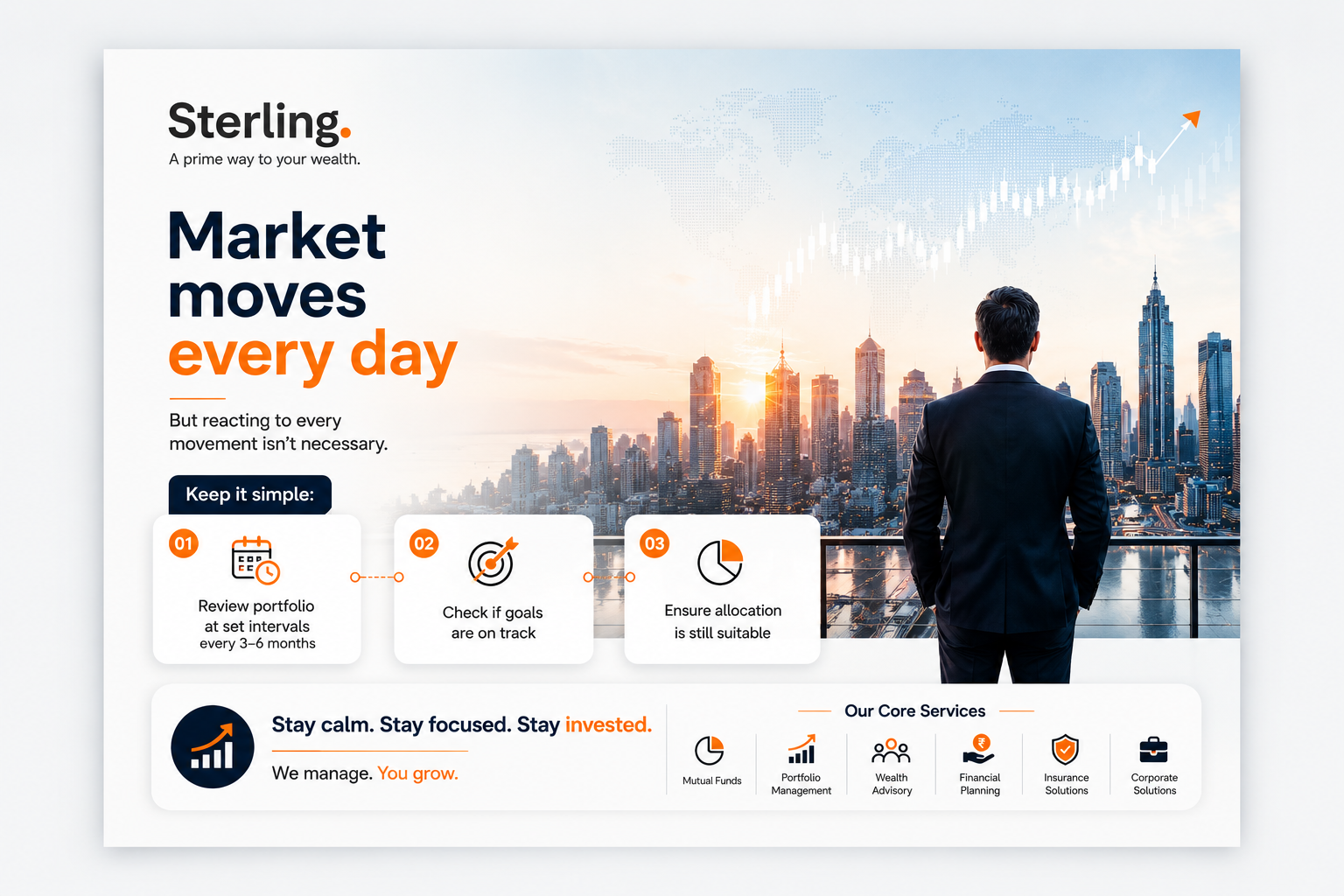
Market Moves Every Day—But Your Investment Strategy Shouldn’t
Financial markets are constantly moving.
One day, the headlines celebrate a market rally. The next day, investors are warned about inflation, interest rates, geopolitical tensions or a possible correction. With every new development, it can feel as though your portfolio demands an immediate response.
But reacting to every market movement is rarely necessary.
Successful investing is not about responding to every headline or predicting every short-term market direction. It is about following a disciplined, goal-oriented strategy that reflects your financial objectives, investment horizon and ability to manage risk.
The market may move every day. Your long-term financial plan should be more stable.
Why Daily Market Movements Feel So Important
Short-term market fluctuations naturally attract attention. When investment values rise, investors may fear missing out on further gains. When markets decline, the fear of losing money can lead to panic-driven decisions.
This emotional cycle can encourage investors to:
- Buy investments after prices have already risen sharply
- Exit quality investments during temporary corrections
- Frequently switch between funds or asset classes
- Make decisions based on headlines instead of financial goals
- Abandon a carefully designed long-term plan
Market volatility is a normal feature of investing. The more important question is not, “What did the market do today?” but, “Is my portfolio still aligned with what I want to achieve?”
The Cost of Reacting to Every Market Movement
Frequent portfolio changes may create more problems than they solve.
1. Emotional decision-making
Investment decisions driven by fear or excitement can cause investors to buy high and sell low—the opposite of a disciplined investment approach.
2. Attempting to time the market
Consistently predicting market highs and lows is extremely difficult. Missing even a few periods of market recovery may affect the long-term outcome of a portfolio.
3. Losing focus on financial goals
A portfolio should be designed around objectives such as retirement, children’s education, purchasing a home or building long-term financial security. Daily price movements do not necessarily change these goals.
4. Unnecessary portfolio activity
Frequent buying, selling or switching can result in transaction costs, taxes, exit loads and a portfolio that becomes increasingly difficult to manage.
5. Disturbing the power of compounding
Long-term investing allows returns to potentially generate further returns over time. Constantly interrupting the investment journey can reduce the opportunity for compounding to work effectively.
Keep Investing Simple: Three Things That Matter
Instead of tracking every market movement, investors can focus on three essential practices.
1. Review Your Portfolio at Set Intervals
A portfolio needs regular attention, but regular does not mean daily.
For many long-term investors, a structured review every three to six months may be more meaningful than reacting to every short-term fluctuation. The appropriate review frequency will depend on the investor’s portfolio, goals and personal circumstances.
A portfolio review should examine:
- Performance against appropriate benchmarks
- Progress towards financial goals
- Changes in risk exposure
- Portfolio diversification
- Costs and tax implications
- Continued suitability of individual investments
The objective is not to make changes during every review. It is to determine whether any change is genuinely required.
2. Check Whether Your Financial Goals Are on Track
Every investment should have a purpose.
During a portfolio review, ask:
- Is the target amount still realistic?
- Am I investing enough to reach it?
- Has the timeline changed?
- Has inflation affected the estimated future cost?
- Has my income or financial responsibility changed?
- Is the portfolio taking too much—or too little—risk?
A market correction does not automatically mean that your plan has failed. Similarly, a market rally does not necessarily mean that you can ignore your contribution targets.
What matters is whether the overall financial plan remains on course.
3. Ensure Your Asset Allocation Is Still Suitable
Asset allocation refers to how investments are distributed across categories such as equity, debt, gold and cash or cash equivalents.
Each asset class performs differently under different market conditions. A diversified allocation can help balance growth potential, liquidity requirements and risk.
Over time, market movements may cause the portfolio to drift away from its intended allocation. For example, a strong rise in equities may increase the equity portion beyond the investor’s preferred risk level.
Rebalancing can help restore the portfolio to its planned allocation. However, it should be based on the investor’s goals and risk profile—not on short-term predictions.
SEBI’s investor-education guidance also highlights the importance of matching investments with the appropriate time horizon and assessing goals, expenses and risk tolerance while constructing a portfolio.
When Should You Consider Changing Your Portfolio?
Staying disciplined does not mean that a portfolio should never change. A review may be necessary when:
- Your financial goals have changed
- Your income or expenses have materially changed
- You are approaching an important goal
- Your ability or willingness to take risk has changed
- Your asset allocation has moved significantly from its target
- An investment no longer matches its stated objective
- There has been a major change in your family or financial circumstances
- The original reason for selecting an investment is no longer valid
The distinction is important: changes should be driven by your financial plan, not by temporary market noise.
Market Volatility and Long-Term Perspective
Volatility can be uncomfortable, but short-term fluctuations are not necessarily an indication that a long-term strategy is failing.
Investors with long investment horizons may have more time to navigate market cycles. In contrast, money required in the near future generally needs a more conservative approach because there may not be enough time to recover from market fluctuations.
This is why the same investment strategy cannot be suitable for every goal. Retirement planned several decades away and a home purchase planned two years from now require different approaches.
A suitable strategy connects each financial goal with an appropriate:
- Investment horizon
- Asset allocation
- Risk level
- Contribution amount
- Review schedule
The Role of Professional Wealth Management
As wealth grows, managing investments may involve more than selecting individual products. Investors may need to coordinate multiple goals, tax considerations, cash-flow requirements, insurance needs and different asset classes.
A structured wealth-management process can help investors:
- Define measurable financial goals
- Understand their risk profile
- Create a suitable asset allocation
- Monitor portfolio progress
- Rebalance investments when required
- Avoid decisions driven purely by market emotions
The purpose is not to eliminate market risk. It is to ensure that investment decisions remain connected to the investor’s broader financial plan.
Stay Calm. Stay Focused. Stay Invested.
Markets will continue to rise, fall and respond to new information. Headlines will change, forecasts will be revised and short-term uncertainty will remain a part of investing.
Your response does not have to change every day.
Review your portfolio at appropriate intervals. Check whether your financial goals remain on track. Ensure that your asset allocation continues to match your investment horizon and risk profile.
Most importantly, avoid allowing temporary market movements to take control of a long-term financial strategy.
The market moves. Discipline keeps your wealth journey moving in the right direction.
Let Sterling Prime Help You Stay on Track
At Sterling Prime, we help investors approach wealth creation with clarity, discipline and a goal-oriented perspective.
To discuss a structured review of your investments and financial goals, visit www.sterlingprime.in.
Stay calm. Stay focused. Stay invested.
We manage. You grow.
Disclaimer
This article is intended solely for educational and informational purposes and should not be considered investment, legal or tax advice. Investment decisions should be made after evaluating individual financial goals, investment horizons and risk profiles, preferably in consultation with a qualified professional.
Mutual Fund investments are subject to market risks; read all scheme-related documents carefully.