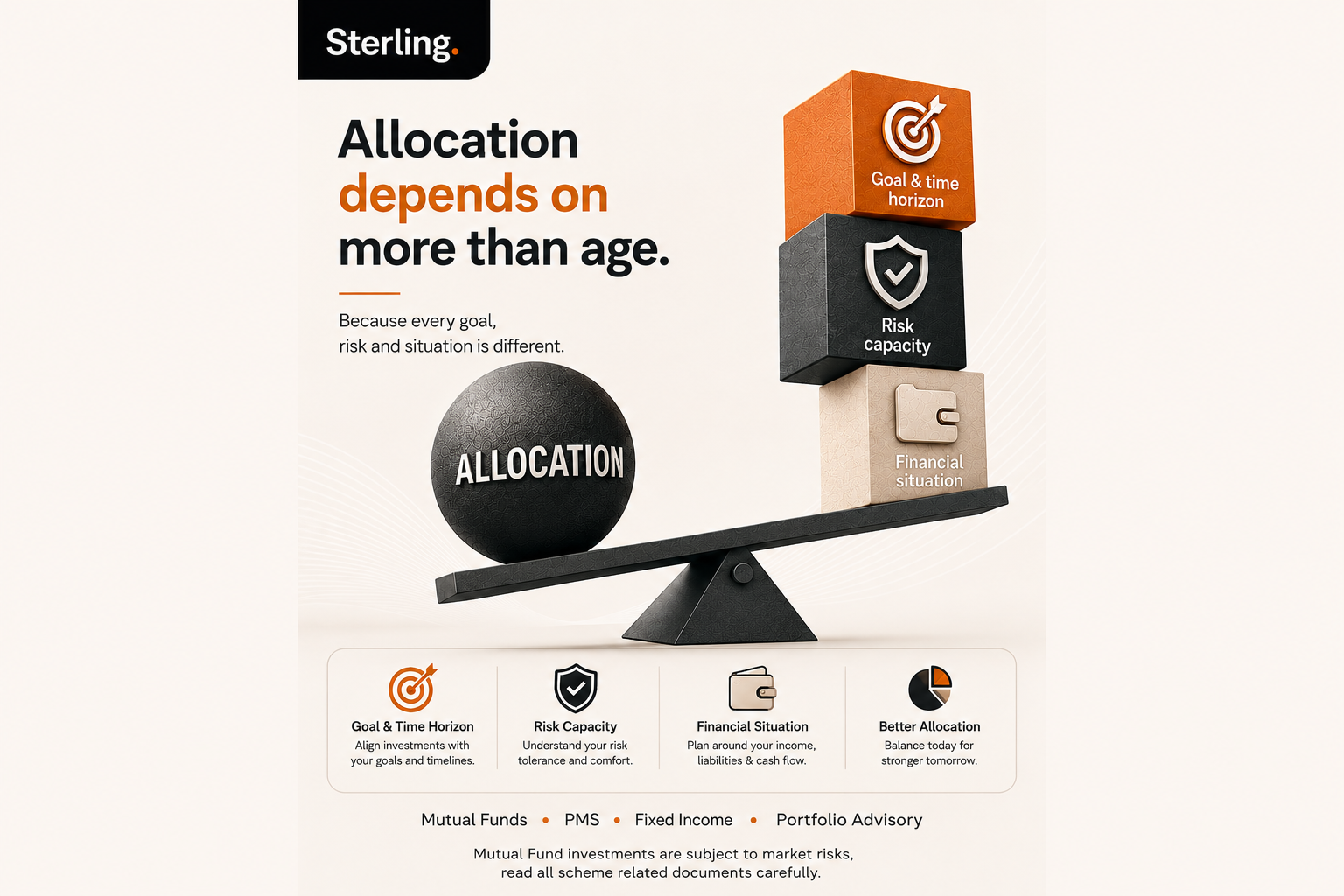
Asset Allocation Depends on More Than Age
One of the most common approaches to investing is to determine asset allocation primarily on the basis of age.
Younger investors are often encouraged to take more equity exposure, while investors approaching retirement are generally advised to move towards relatively conservative assets.
Age certainly matters—but it should not be the only factor deciding your portfolio.
Two investors of the same age can have completely different incomes, liabilities, financial responsibilities, investment objectives and risk-taking abilities. Giving both investors the same asset allocation simply because they belong to the same age group can therefore overlook some of the most important aspects of financial planning.
A more thoughtful approach starts with four questions:
What are you investing for? How much time do you have? How much risk can you actually afford? And what does your current financial situation look like?
Why Age Alone Cannot Define Your Asset Allocation
Consider two investors who are both 40 years old.
One may have a stable income, limited liabilities, adequate emergency savings and a 15-year investment horizon.
The other may have substantial loan obligations, upcoming education expenses and a financial goal that needs to be funded within three years.
Their age is identical.
Their financial circumstances are not.
This is why effective asset allocation needs to go beyond demographic rules and consider the investor's broader financial picture.
1. Start With Your Financial Goals
Every investment should ideally have a purpose.
Your objective could be retirement, children's education, buying a home, building long-term wealth or creating a corpus for another important financial milestone.
Different goals require different investment strategies.
A portfolio designed for a goal that is 15 years away can potentially accommodate a different level of volatility than money required within the next two or three years.
The question therefore shouldn't simply be:
“How old am I?”
It should also be:
“What am I investing for?”
2. Your Time Horizon Changes the Equation
Time horizon and asset allocation are closely connected.
Longer investment horizons may provide investors with more time to navigate market cycles and short-term volatility. Shorter horizons generally require greater attention to capital preservation, liquidity and predictability.
For example, money required for a financial obligation next year should normally be viewed very differently from a retirement corpus being accumulated over the next two decades.
The closer the goal, the more important the time horizon becomes.
3. Risk Capacity Is Different From Risk Appetite
Investors often describe themselves as aggressive, moderate or conservative.
But willingness to take risk and financial capacity to absorb risk are not necessarily the same thing.
An investor may emotionally be comfortable with market fluctuations but still have limited capacity for losses because of high liabilities, irregular income or near-term financial commitments.
Conversely, another investor may have substantial financial capacity but personally prefer lower volatility.
A sound allocation strategy should consider both dimensions rather than relying on a generic risk label.
4. Your Financial Situation Matters
Asset allocation should also reflect your broader financial position.
Income stability, existing investments, debt obligations, emergency reserves, expected cash requirements and other financial responsibilities can influence how much risk is appropriate.
For instance, an investor with significant near-term liabilities may need greater liquidity even if their age theoretically suggests a more aggressive portfolio.
Your investment portfolio should therefore work with your financial life—not independently of it.
5. Diversification Is More Than Owning Multiple Investments
A portfolio containing many products isn't automatically well diversified.
True diversification involves understanding how different assets behave, what role each investment serves and whether the overall portfolio remains aligned with the investor's objectives.
Depending on individual circumstances, an investment strategy may involve exposure across areas such as mutual funds, fixed-income investments, professionally managed portfolios and other suitable asset classes.
The objective isn't to own everything.
It is to determine an appropriate mix for the investor.
Asset Allocation Is Not a One-Time Decision
Even a carefully constructed portfolio can become misaligned over time.
Markets move. Income changes. Liabilities reduce or increase. Goals become closer. New responsibilities emerge.
Portfolio allocations can also drift simply because one asset class performs better than another.
This makes periodic portfolio reviews and rebalancing an important part of long-term investment management.
The portfolio that suited you five years ago may not necessarily be the portfolio you need today.
Better Allocation Begins With Better Questions
Instead of asking only:
“What should someone my age invest in?”
A more useful conversation considers:
What are my goals? When will I need the money? What level of loss can my finances withstand? How stable is my cash flow? What liabilities do I have? And how does my existing portfolio fit into the bigger picture?
These questions provide a much stronger foundation for investment decisions.
The Bottom Line
Age can provide useful context for investment planning, but it should never become the entire strategy.
Effective asset allocation brings together your goals, time horizon, risk capacity and financial situation to create a portfolio that reflects your actual circumstances.
Because ultimately, good investing isn't about fitting an investor into a formula.
It's about building an allocation around the investor.
At Sterling Prime, the focus is on helping investors evaluate their financial objectives and build thoughtful investment strategies across Mutual Funds, PMS, Fixed Income and Portfolio Advisory.
Better allocation today can help create a stronger financial foundation for tomorrow.
Disclaimer: Investments are subject to applicable market and investment risks. Mutual Fund investments are subject to market risks. Read all scheme-related documents carefully before investing. The information above is intended for general educational purposes and should not be construed as personalised investment advice.